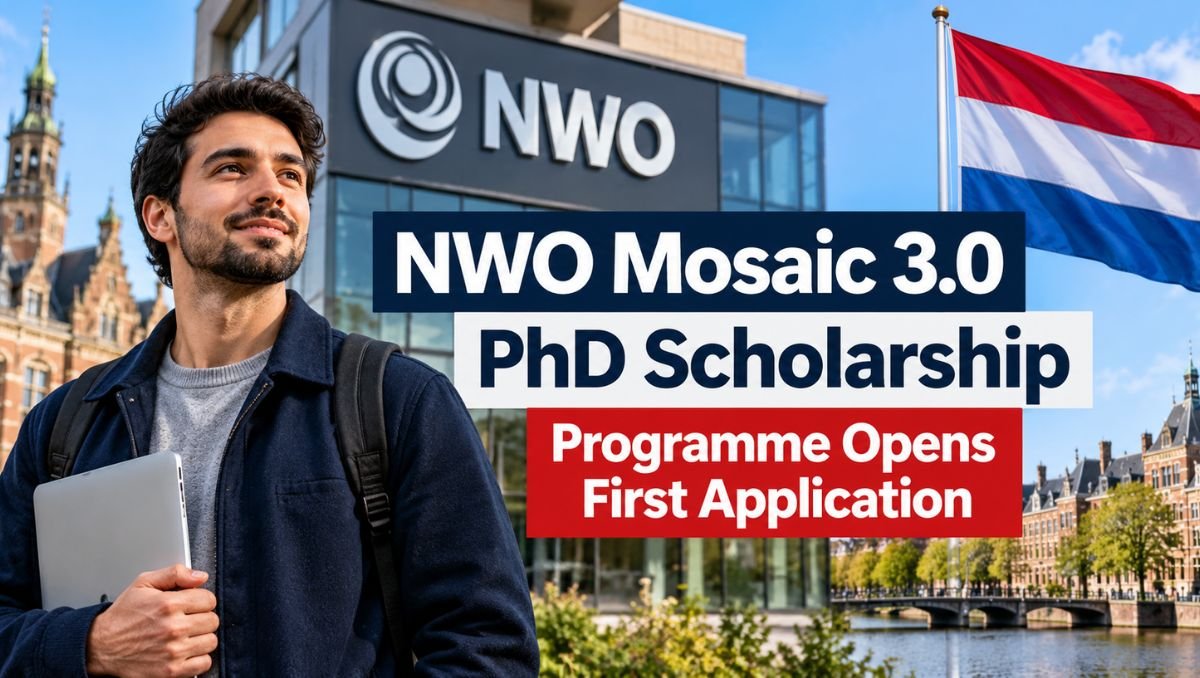
The Dutch Research Council (NWO) has opened the first application round of Mosaic 3.0, a PhD scholarship programme for researchers from specific underrepresented migration and recent asylum backgrounds who want to pursue doctoral research in the Netherlands. The programme has a total budget of €7.4 million, with up to €420,000 available per project.
Mosaic 3.0 is open across academic disciplines rather than being limited to a particular research topic. However, applicants must meet the specific eligibility conditions for one of the programme’s two target groups.
Mosaic 3.0 at a glance
| Detail | Information |
|---|---|
| Programme | Mosaic 3.0 PhD Scholarship Programme |
| Organisation | Dutch Research Council (NWO) |
| Location | Netherlands |
| Study level | PhD |
| Research fields | All academic disciplines |
| Total budget | €7.4 million |
| Maximum funding | €420,000 per project |
| Maximum awards | Up to 18 projects |
| Funding duration | Up to 4 years full-time or equivalent part-time duration |
| Application process | Two stages |
| Pre-proposal deadline | 3 November 2026 |
| Full proposal deadline | 4 May 2027 |
What is the NWO Mosaic 3.0 programme?
Mosaic 3.0 is designed to support the recruitment and development of researchers from groups that are underrepresented in Dutch academia.
The programme has two target groups. The first concerns researchers with a non-European migration background, while the second covers researchers with a recent asylum background.
The programme also expands on earlier NWO initiatives, including Mosaic and Hestia, by bringing the relevant target groups together under the updated Mosaic 3.0 framework.
Importantly, applicants are not required to propose research specifically about migration, diversity or discrimination. The programme accepts research proposals across academic disciplines.
Who can apply for Mosaic 3.0?
Mosaic 3.0 has separate eligibility routes, so applicants need to determine which target group applies to their circumstances.
Group 1: Non-European migration background
The first group is aimed at researchers with a non-European migration background.
The programme’s specified backgrounds include:
- Africa
- Asia
- The Caribbean
- Central America
- South America
- Turkey
- Indigenous peoples of North America
- Indigenous peoples of Oceania
Applicants in this group must also satisfy the programme’s other eligibility requirements. A qualifying migration background alone does not establish eligibility.
The eligibility conditions include requirements concerning the applicant’s academic background and connection with the Netherlands, so prospective applicants should check the complete NWO conditions before preparing a proposal.
Group 2: Recent asylum background
The second group is intended for researchers with a recent asylum or refugee background.
This route includes junior researchers with a master’s-level academic background and also covers researchers from Ukraine under the relevant protection arrangements.
Group 2 has its own eligibility requirements and assessment structure, so applicants should not assume that the conditions for Group 1 apply to them.
What research can applicants propose?
Mosaic 3.0 does not prescribe a specific research subject.
Applicants can therefore develop a PhD research proposal in the academic field that matches their research interests and proposed project. The programme can consequently be relevant to researchers working in areas such as social sciences, law, science, technology, health, engineering, humanities and other academic disciplines.
The absence of a prescribed subject does not mean that every proposal will qualify. Applicants still need to satisfy the programme’s eligibility requirements and meet the relevant academic and assessment conditions.
How much funding is available?
The total budget for this Mosaic 3.0 round is €7.4 million.
The funding is divided between the two target groups:
- €5 million is allocated to Group 1.
- €2.4 million is allocated to Group 2.
NWO allows applicants to request up to €420,000 per project. The programme expects to fund a maximum of 18 projects in this round.
The funding supports a PhD research position rather than being described simply as a one-time payment to individual applicants.
How long can the PhD funding last?
The programme provides funding for up to four years for a full-time appointment at 1.0 FTE.
It can also cover the equivalent duration on a part-time basis, up to eight years at 0.5 FTE.
The exact arrangement should be considered as part of the proposed research and supervisory setup.
How does the Mosaic 3.0 application process work?
The application process has two stages: a pre-proposal followed by a full proposal.
Stage 1: Submit a pre-proposal
The first stage requires applicants to submit a pre-proposal.
The deadline for the first round is:
3 November 2026 at 14:00 CEST
Applicants should allow sufficient time to develop their research idea and complete the required application materials.
Stage 2: Submit a full proposal
Applicants who proceed to the next stage will be invited to submit a full proposal.
The deadline for the full application is:
4 May 2027 at 14:00 CET
The two-stage structure means that applicants should plan for both deadlines rather than treating the November submission as the end of the process.
Do applicants need a PhD supervisor?
Yes. The application involves an academic supervisory arrangement.
Candidates are expected to develop their proposal in consultation with the intended supervisor and daily supervisor. The application also requires a statement from the intended supervisor.
This makes identifying a suitable Dutch academic environment and potential supervisor an important part of preparing an application.
Applicants should therefore begin discussions with relevant researchers well before the pre-proposal deadline.
What should applicants prepare?
Prospective candidates should first establish whether they meet the eligibility requirements for Group 1 or Group 2.
They can then work through the following preparation steps:
- Check the complete NWO eligibility conditions for the relevant target group.
- Develop an initial PhD research idea.
- Identify a suitable Dutch research environment.
- Find an intended supervisor whose expertise fits the proposed research.
- Discuss the project with the intended and daily supervisors.
- Prepare the required supervisor statement and other application materials.
- Submit the pre-proposal by 3 November 2026.
- If invited to continue, prepare and submit the full proposal by 4 May 2027.
The supervisory requirement is particularly important because candidates are expected to develop their proposal in consultation with their academic supervisors.
Important dates for Mosaic 3.0
| Application stage | Deadline |
|---|---|
| Pre-proposal | 3 November 2026, 14:00 CEST |
| Full proposal | 4 May 2027, 14:00 CET |
Applicants should pay attention to the stated time zones when planning their submissions.
Who is Mosaic 3.0 for?
Mosaic 3.0 is specifically aimed at researchers from the programme’s defined underrepresented groups, rather than being a general PhD scholarship open to all applicants.
For that reason, prospective applicants should check the detailed eligibility requirements before investing significant time in preparing a proposal.
The programme’s two routes also have different conditions. Applicants should identify the correct route based on their migration or asylum background and then follow the corresponding requirements.
Why the programme may interest prospective PhD researchers
Mosaic 3.0 combines PhD funding with considerable flexibility over the research subject. There is no prescribed academic discipline, while the programme provides substantial project funding and allows full-time or equivalent part-time PhD arrangements.
At the same time, the programme has a narrowly defined target population and a competitive selection process. NWO expects to support no more than 18 projects in this round, so meeting the basic eligibility requirements does not by itself guarantee funding.
For eligible researchers, the immediate priority is to understand the applicable eligibility route, develop a credible research idea and establish contact with an appropriate academic supervisor before the first deadline.
