
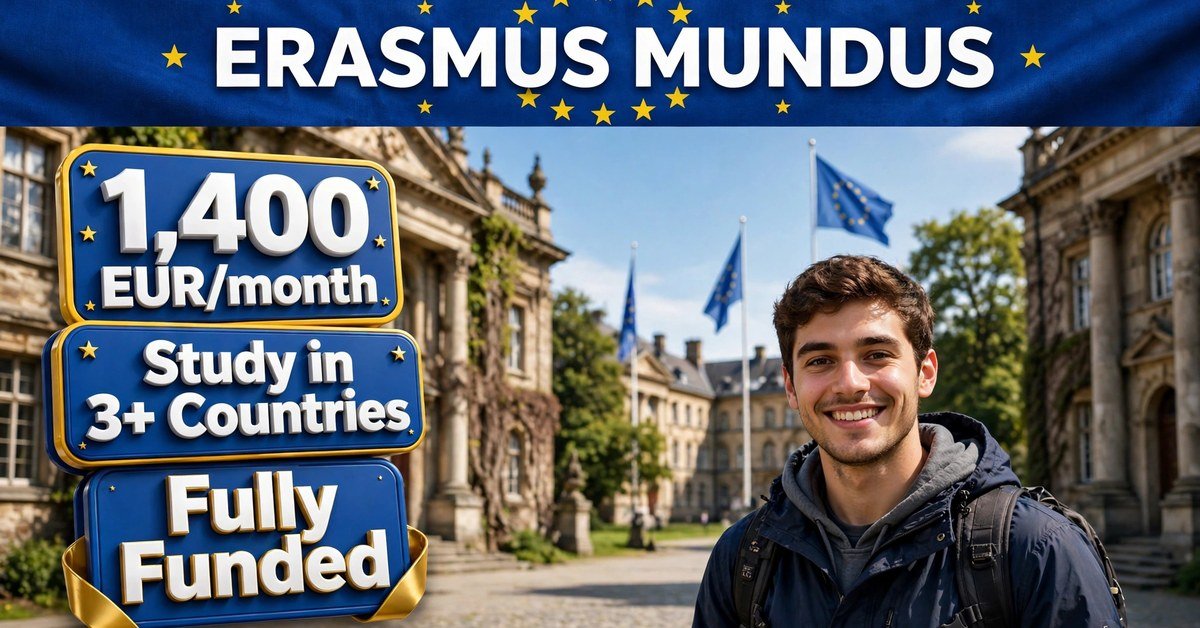
The European Union will pay you 1,400 euros a month to study international law in three or more European countries. The Erasmus Mundus Joint Master in International Law of Security, Peace and Sustainable Development covers the full 24 months — and tuition is waived entirely.
Applications for the second intake (2027–2029) with an Erasmus Mundus scholarship close on 4 January 2027 at 23:59 CET. Self-funded applicants get more time, until 31 March 2027. If a funded European master is your goal, keep reading.
The key details at a glance
| Detail | What the official site says |
| Programme | ILSPSD — Erasmus Mundus Joint Master |
| Coordinated by | Leuphana University of Lüneburg, Germany |
| Duration | 24 months, full-time, October intake |
| Countries | Germany, Spain, then Scotland, Belgium, Portugal or Estonia (3+ countries) |
| Scholarship | €1,400/month for 24 months + full tuition exemption |
| Scholarships available | 70 across the first four intakes |
| Deadline (scholarship) | 4 January 2027, 23:59 CET |
What the scholarship actually covers
The figure is 1,400 euros per month for the entire 24-month programme. The official page describes it as a contribution to travel, visa, installation, and living costs. On top of the monthly amount, scholarship holders pay no tuition fees at all.
Seventy scholarships are spread across the first four intakes, with roughly a quarter awarded per intake. Students from any region of the world can receive them, though as a general rule no more than 10 percent of scholarships go to students of the same nationality — with exceptions for targeted regions.
The scholarship categories reflect EU funding lines. Thirty go to EU Member States and associated countries such as Norway, Iceland, and Türkiye. Twenty go to other third countries. Additional targeted scholarships — 2 for IPA III countries and 18 for NDICI regions — are reserved for specific developing regions. In plain terms: applicants from developing regions have dedicated places.
How the two years are structured
Mobility is the heart of this programme. Everyone starts at Leuphana University of Lüneburg in Germany, studying international law of security, peace and sustainable development on either an LL.M. or M.A. track. Then you move to the Institut Barcelona d’Estudis Internacionals in Spain for theories of international security.
For the second year, you specialise in one of four tracks: International Law and International Security at the University of Glasgow, Security and Conflict at the Université libre de Bruxelles, Globalization, Law and Security at NOVA University Lisbon, or International Law and Human Rights at the University of Tartu in Estonia.
The final semester is devoted to a research dissertation, with an optional work placement. Summer schools, legal clinics, and guest lectures with practitioners run throughout. You graduate with a genuinely international profile and a network spanning six countries.
Who should apply — and who should not
This master is for graduates who want to work in international law, policy, diplomacy, or global affairs — international courts, the EU, ministries, NGOs, or think tanks. The curriculum blends law with politics, sustainability, and security studies, so it suits people who think across disciplines rather than inside one box.
You should probably not apply if:
- You cannot commit to two years of full-time study across multiple countries.
- You want a purely domestic degree — mobility is mandatory, not optional.
- You miss the 4 January scholarship deadline and cannot fund yourself (self-funded applications run until 31 March, but without the €1,400 a month).
How to apply
You apply through the official application platform, reached from the consortium’s website. The site asks you to read the step-by-step application guide carefully before starting — do that, because Erasmus Mundus applications are detailed and incomplete files are not considered.
Decide first whether you are applying for the EMJM scholarship or as a self-funded student, because the deadlines differ. Prepare your academic documents early, and submit well before 4 January if you want the scholarship.
More fully funded scholarships: the Clarendon Fund at Oxford, the Weidenfeld-Hoffmann Scholarships, and the KAUST Scholarships in Saudi Arabia.
Questions applicants ask
How much is the Erasmus Mundus scholarship for ILSPSD?
1,400 euros per month for the full 24 months, plus full exemption from tuition fees. It is described as a contribution to travel, visa, installation, and subsistence costs.
When is the application deadline?
For the EMJM scholarship (second intake, 2027–2029): 4 January 2027 at 23:59 CET. Self-funded applicants can apply until 31 March 2027 at 23:59 CEST.
Which countries will I study in?
All students start in Germany (Leuphana) and continue in Spain (IBEI Barcelona), then specialise in Scotland (Glasgow), Belgium (ULB), Portugal (NOVA Lisbon), or Estonia (Tartu) — three or more countries in total.
Can students from my country apply?
Scholarships are open to students from any region of the world, with dedicated places for EU/associated countries, other third countries, and targeted regions. As a general rule, no more than 10% of scholarships go to one nationality.
Is it an LL.M. or an M.A.?
The programme offers both tracks at Leuphana — you choose the LL.M. or M.A. study track.
What careers does it lead to?
According to the consortium: international courts and organisations, the EU, ministries and government agencies, NGOs, think tanks, and related fields in law, policy, and diplomacy.

One thought on “Erasmus Mundus Scholarship: A Two-Year Law Master Across Six European Countries”