
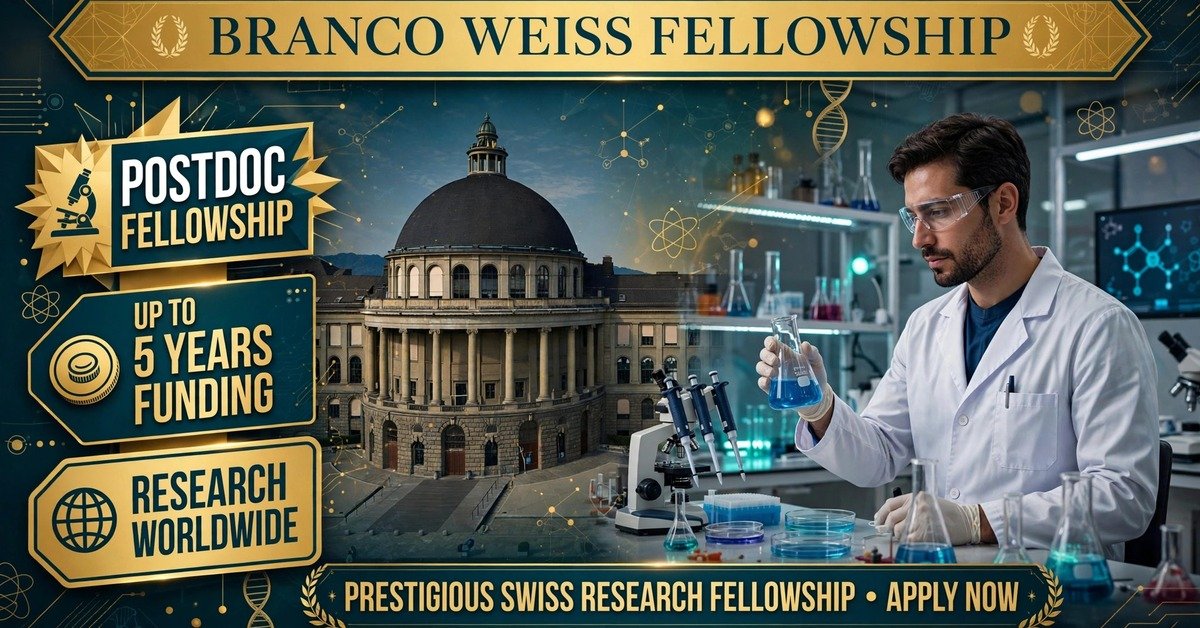
The Branco Weiss Fellowship gives postdoctoral researchers up to five years of funding for unconventional research ideas — projects outside the mainstream that cross disciplinary borders. Up to ten fellowships are awarded each year, and registration for the 2027 intake is open now, closing 15 January 2027 at 5 p.m. CET.
This is not a standard postdoc position tied to a professor’s grant. You propose your own project, choose your host institution anywhere in the world, and the funds are paid directly to you. That combination of freedom and time is rare — and the competition is intense.
What makes this fellowship different from a normal postdoc
Most postdoctoral positions hire you to work on someone else’s funded project, in their lab, on their timeline. This fellowship works the other way around: you bring the research idea, and the fellowship funds you to carry it out. It is explicitly built for projects that do not fit neatly into one discipline — ideas that struggle for normal funding because they fall between fields.
Based at ETH Zurich, it supports work across all disciplines, from natural sciences and engineering to humanities and social sciences. The five-year duration is the other striking feature: most postdoc contracts last one to two years, forcing quick, safe results — five years lets you take on a genuinely risky question and follow it where it leads.
The freedom most postdocs never get
Two features deserve special attention because they change how you can work. First, you choose your host institution anywhere in the world — you are not required to be in Zurich or Switzerland, just at the university or institute that fits your project best.
Second, the funds are paid directly to the fellow rather than through a host department’s budget. You are not an employee on a supervisor’s project — you are the principal investigator of your own research programme from day one. For an early-career researcher, that independence is usually years away.
Key details at a glance
| Detail | Information |
|---|---|
| Organisation | Branco Weiss Fellowship, based at ETH Zurich, Switzerland |
| Programme | Branco Weiss Fellowship 2027 |
| Who it is for | Postdoctoral researchers across all disciplines |
| Duration | Up to five years |
| Fellowships per year | Up to ten |
| Project type | Unconventional projects beyond the mainstream |
| Host institution | Chosen by the fellow, anywhere in the world |
| Funding | Generous multi-year funding paid directly to the fellow |
| Registration deadline | 15 January 2027, 5 p.m. CET |
Does your project fit? An honest self-check
This fellowship is not for every good postdoc project — it is for a specific kind. Does your research question sit between established fields, or challenge how a field normally works? An excellent but conventional next step in your discipline fits a standard postdoc grant better. The Branco Weiss panel looks for ideas that make reviewers pause, not nod.
You are a strong fit if you have a clear, original question that needs several years to answer, can explain why no existing funding scheme fits it, and know its best institutional home worldwide. You are probably not a fit if you have not yet finished your PhD, or if your project depends entirely on one professor’s lab.
How to apply
Start by reading the eligibility rules on the official fellowship website in full — the definitions of who counts as a postdoctoral researcher are precise, and they are the first filter. Then refine your project description until your unconventional idea is clear to a smart scientist outside your field.
Next, identify your preferred host institution and make early contact. Even though you choose it yourself, a serious conversation with a potential host proves the project is feasible. Complete your registration on the official portal before 15 January 2027 at 5 p.m. CET — the deadline is strict.
How to frame an “unconventional” idea without sounding vague
The hardest part is proving your project is unconventional in a serious way, not just unusual on paper. What convinces panels is a precise explanation of which assumption in your field your project questions — name the assumption. That single sentence does more work than pages of adjectives.
Be equally concrete about the risk. An unconventional project should have a real chance of failing, and the panel knows it — show them what failure would still teach the field. A project guaranteed to succeed is, by definition, not unconventional.
Finally, keep your language accessible. The panel includes researchers from many disciplines, and your proposal will be read far outside your specialty. If a bright biologist cannot follow your physics proposal’s core idea — or the reverse — it will not survive. Write for breadth; let your references carry the depth.
What the five years actually buy you
Five years of independent funding changes a research career in a way one-year contracts cannot. It gives you time to build a new method, learn a second discipline properly, or pursue a result that takes three failed attempts before it works. For researchers whose best ideas need that room, this fellowship is worth far more than its monetary value.
It also changes your standing in the academic job market: arriving at a faculty interview as someone who ran their own funded programme for five years puts you in a different category. Treat the fellowship as a career platform, not just a grant.
Looking for more fellowship opportunities? Also see the Dalai Lama Fellows and the World Bank Government Analytics Fellowship 2027.
Frequently asked questions
Do I have to be based in Zurich or Switzerland?
No. You choose your host institution anywhere in the world; your research can be based wherever fits the project best.
How much funding does the fellowship provide?
The official home page does not state a figure — it describes generous multi-year funding paid directly to the fellow for up to five years.
Is it only for science and engineering?
No — it supports unconventional projects across all disciplines, including humanities and social sciences.
How many fellowships are awarded?
Up to ten per year — selection is highly competitive.

One thought on “Branco Weiss Fellowship 2027 (ETH Zurich)”