
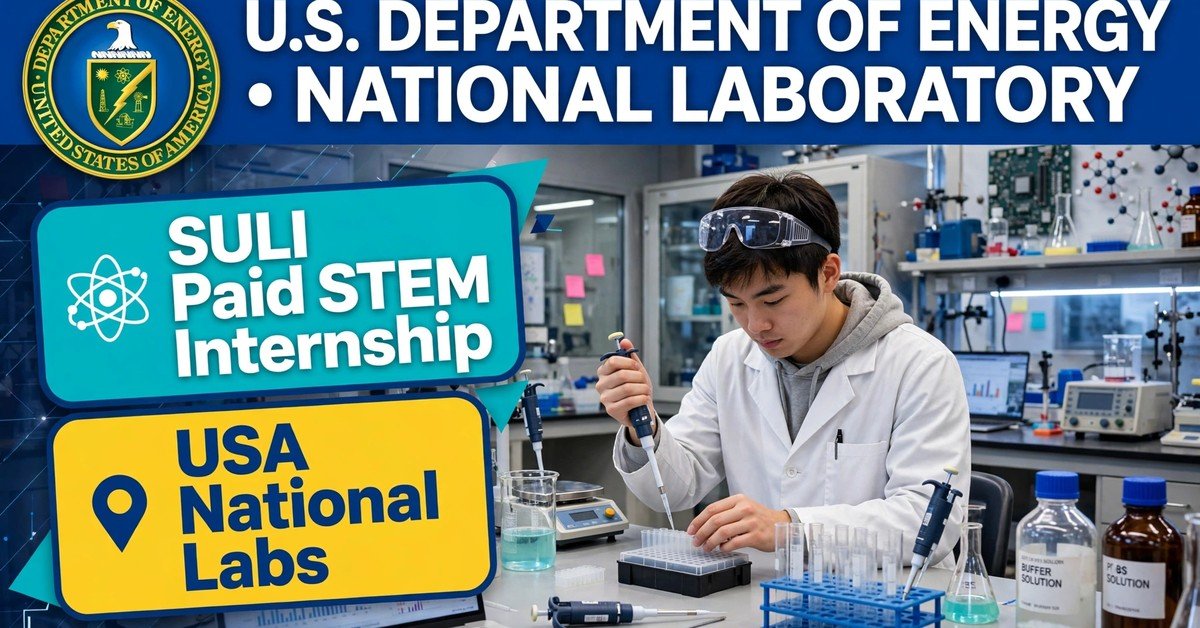
The Science Undergraduate Laboratory Internships (SULI) programme gives undergraduate students a paid, full-time research placement at a United States Department of Energy (DOE) national laboratory. Interns spend 10 weeks in the summer term on a real research project under a laboratory scientist or engineer. Applications close on 6 January at 5:00 PM Eastern Time; only complete applications are considered.
SULI is run by the DOE Office of Science. There are 17 participating national laboratories, and applicants choose the laboratories and research areas that interest them most.
Read this first: the citizenship rule
This is the most important restriction in the programme, and it decides whether you should apply at all. You must be a United States citizen or a lawful permanent resident at the time you apply. International students on a student visa are not eligible, and neither are applicants abroad without one of these two statuses. No visa sponsorship is stated, so do not assume visa help is available.
Accepted applicants must prove their status when they accept an offer, using documents such as a certified birth certificate or a United States passport, or, for lawful permanent residents, a current Permanent Resident Card (Form I-551). Lawful permanent residents should also contact their chosen laboratory during the application period, because extra time may be needed to approve site access.
Key details at a glance
| Detail | What the official programme states |
|---|---|
| Organisation | U.S. Department of Energy, Office of Science |
| Programme | SULI, summer term |
| Location | DOE national laboratories, USA |
| Duration | 10 weeks, full-time |
| Stipend | $650 per week |
| Travel and lodging | Travel reimbursement and lodging support |
| Deadline | 6 January at 5:00 PM Eastern Time |
| Who can apply | U.S. citizens and lawful permanent residents only |
What you actually do at the laboratory
This is not office work or shadowing. You join a research team and work on a project from the laboratory’s ongoing research, with a scientist or engineer as mentor. Laboratories cover fields such as energy, computing, materials, biology, physics and environmental science, so the exact project depends on the team that selects you.
Who can apply
SULI is open to two groups: current full-time undergraduates at an accredited college, and recent graduates who finished an undergraduate degree. For recent graduates, no more than two years may have passed between receiving the degree and the start of the internship.
Every applicant must also meet academic rules by the deadline. You must hold a high school diploma or equivalent, have completed at least one semester as a matriculated undergraduate, hold at least 6 credit hours in STEM subjects and at least 12 total credit hours, and hold a cumulative GPA of at least 3.0 on a 4.0 scale. You must be at least 18 when the internship begins, with a limit of two SULI internships and four applications overall.
What you are paid, and what it covers
Participants receive a stipend of $650 per week, which adds up to $6,500 over the 10-week term. This is a stipend, not a salary, so plan your summer budget around this figure. Selected students are also reimbursed for one round trip of domestic travel, noted for those living more than 50 miles from the laboratory, and lodging support is offered, though its form can differ by laboratory.
How to choose your laboratories wisely
Your application asks you to name laboratory choices and research interests, and this choice matters. Start from the topics you enjoy in your coursework, then look for laboratories working in those areas, rather than picking names you have simply heard of. The programme’s free events can help: the virtual internship fair lets you speak with laboratory representatives, and the application workshops explain how to submit a compliant application. Also weigh up location, since a 10-week stay means finding somewhere to live nearby.
How to apply
Applications are made online through the official SULI application system, and a complete application has several parts. You must list up to three laboratories, propose a research topic, and provide a personal statement, transcripts, and recommendations. Applying early is sensible: the system will not accept late or incomplete applications, and the deadline is 6 January at 5:00 PM Eastern Time.
Transcripts need care, because a mistake here can make your application non-compliant. Both official and unofficial transcripts are acceptable, but every transcript must show your name and the institution’s name, and all completed and in-progress coursework, with grades. Foreign transcripts must be evaluated and translated into English.
For recommendations, ask early and choose well. You need at least two letters; you may list up to three recommenders, and they must submit their letters by the deadline. A letter should explain why you are ready for laboratory research, not just that you did well in class.
For comparison, see our guides to the OCA Summer Internship in Washington, DC and the Hurford Youth Fellows Program.
Before you spend time on this: a quick self-check
Answer these before gathering documents. Are you a United States citizen or lawful permanent resident? Do you have at least 6 credit hours in STEM subjects, at least 12 total credit hours, and a GPA of at least 3.0? Are you at least 18, and have you used fewer than two SULI internships and four applications in total? If any answer is no, this programme is not a good use of your time this term.
Can international students apply for SULI?
No, not unless they are lawful permanent residents of the United States. Applicants must hold one of these two statuses at the time of application, and proof is required when an offer is accepted.
What happens if my application is incomplete at the deadline?
Only complete applications submitted by 6 January at 5:00 PM Eastern Time are considered, so submit early.

One thought on “Science Undergraduate Laboratory Internships (SULI) at U.S. Department of Energy National Laboratories”