
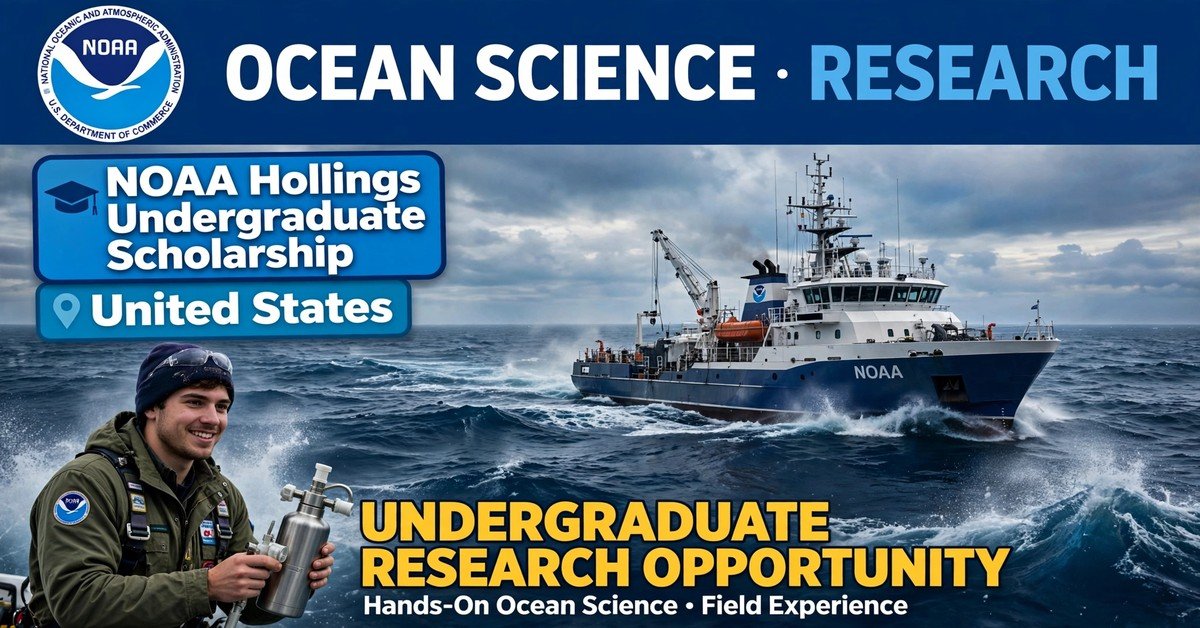
The National Oceanic and Atmospheric Administration (NOAA) offers this scholarship to undergraduate science students. The Ernest F. Hollings Undergraduate Scholarship gives money for study, adds a paid summer internship, and runs for the junior and senior years.
Read this first: only United States citizens can apply
This is the most important rule on the official page. You must be a United States citizen when you apply. There is no exception for residents holding another citizenship.
You must also study at an accredited college or university in the United States or its territories. Applicants should be full-time second-year students in a four-year programme, or full-time third-year students in a five-year programme. Community college and transfer students can apply too, if they show proof of application to a four-year institution.
What the scholarship gives you
The total award package is worth up to $40,000, combining study funding and the paid internship. Study funding is up to $9,500 per year. The internship pays $700 per week for 10 weeks, with $400 per week for housing if you do not live at home.
| Part of the award | What you receive |
|---|---|
| Study funding | Up to $9,500 per year |
| Internship pay | $700 per week, 10 weeks, full-time |
| Housing allowance | $400 per week, if not living at home |
| Travel and events | Orientation, site, symposium, conferences |
Travel support is also included, covering orientation, the site, the final symposium, and up to two conferences. Note the caps: $9,500 per year for study, $40,000 in total.
Who can apply
Along with citizenship, you need a minimum cumulative grade point average of 3.0 on a 4.0 scale, or the equivalent on another stated scale. Stay a full-time student and keep that average until the award is made.
Your major must also fit NOAA’s mission. Listed fields include oceanic, environmental, biological, and atmospheric sciences, mathematics, engineering, remote sensing, and computer science. Teacher education that supports NOAA’s mission is also included. If your major is not listed, compare your course content with NOAA’s work before deciding.
Check yourself before you apply
Check four things first: United States citizenship, the right year of study, a grade point average of at least 3.0, and a major linked to NOAA’s mission. If all four are true, you have a genuine reason to apply. If any one fails, the application cannot succeed.
It is just as useful to know who should not apply. Do not apply in your first or final year, since the award is built around the junior and senior years. Do not apply if your major has no clear link to NOAA’s mission, or if you cannot attend the late-May orientation or complete a 10-week internship.
The two-year path, step by step
Applications are due at the end of January, and recipients are normally notified in April. Successful scholars attend a mandatory orientation in Silver Spring, Maryland, in late May or early June. In the junior year, funding is paid in September and January, and internships are chosen between October and December.
The summer after the junior year is the heart of the programme. The internship starts at the end of May or the start of June. Scholars present their projects in late July or early August at a mandatory final week in Silver Spring, Maryland. In the senior year, funding is paid again in September and January.
How to apply
Applications open in September and close at the end of January, so do not leave everything to the final week. Read the full official page first, then create your account on the official application system. Gather your academic record, proof of enrolment, and transfer proof if needed early.
Ask your referees early, and choose lecturers who know your academic work well. Check before the deadline that their forms have actually been submitted, since a missing reference can sink an otherwise strong application. Write plainly, check every fact, and keep a copy.
The deadline for applications is 31 January at 11:59 PM EST. Do not aim for the final hour, because systems can be slow and uploads can fail. Set a personal deadline at least one week earlier, with every document and reference already in place.
Tips that make a NOAA application stronger
Connect your major to NOAA’s real work in your own words. If you study atmospheric science, name the weather or climate questions that interest you. If you study marine biology, name the ocean problems you want to work on. Reviewers remember specific applications.
Show evidence, not just interest. Mention lab work, fieldwork, coding, data analysis, or research assistance, and say what you did and learned. Do not claim skills you lack, since a supervisor will soon see the gap. Mention a similar placement, such as the Science Undergraduate Laboratory Internships (SULI), if it taught you how research works.
What happens after you apply
Recipients are normally notified in April, so keep late May free for orientation. If you are not selected, remember NOAA awards around 118 scholarships each year. Wider options include the UCL Research Excellence Scholarships and the Glocal Erasmus Mundus Scholarship.
Frequently asked questions
Q: Do I have to be a United States citizen to apply?
A: Yes. Citizenship at the time of application is a firm requirement, with no separate route for other citizenships.
Q: Which year of study should I be in?
A: A full-time second-year student in a four-year programme, or a full-time third-year student in a five-year programme. Transfer students applying to a four-year institution can also apply.
Q: How much money does the scholarship provide?
A: Up to $40,000 in total: up to $9,500 per year for study, a 10-week internship at $700 per week, and $400 per week for housing if away from home.
Q: When do applications close?
A: On 31 January at 11:59 PM EST, so submit at least one week earlier.
