
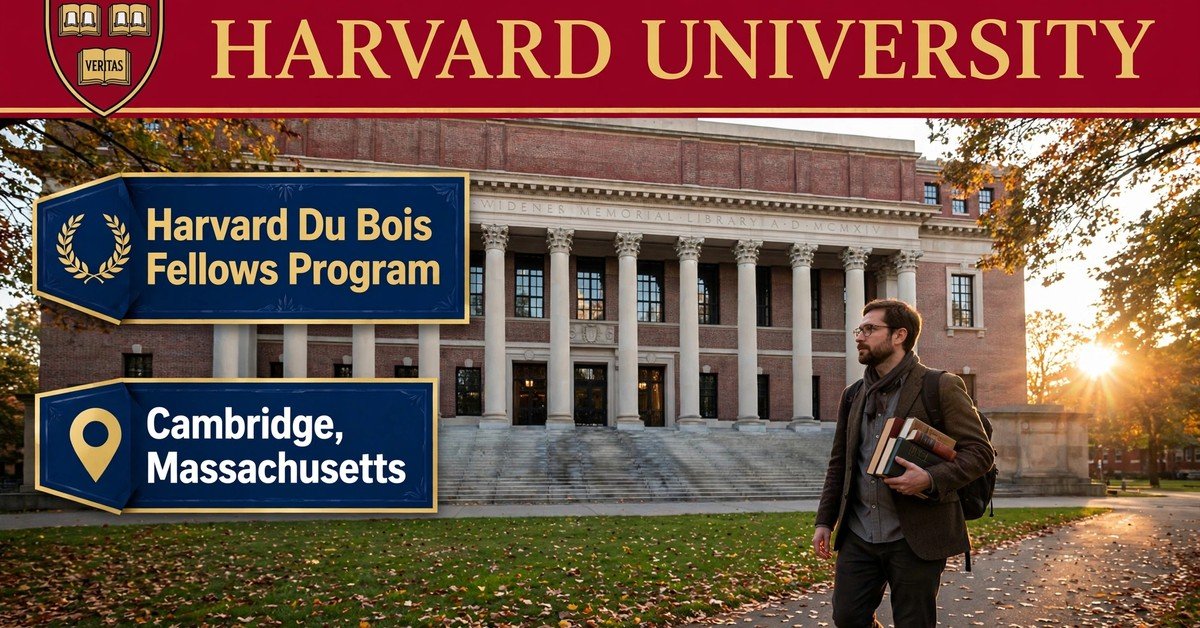
The Harvard W. E. B. Du Bois Fellows Program is a research fellowship run by the Hutchins Center for African & African American Research at Harvard University. It brings scholars to Cambridge, Massachusetts, USA, to spend time in residence and work on research linked to African and African American Studies.
Up to twenty scholars are invited to be in residence each year, and the group reflects the wide range of subjects in African and African American Studies. The fellowship supports research at both the predoctoral and postdoctoral levels, so it suits researchers at two different career stages. If your work sits clearly in this field, this programme deserves a close look.
What being in residence means for you
Being in residence means you spend your fellowship period at the Hutchins Center itself, rather than working from a distance. That matters because this kind of research often depends on libraries, archives, colleagues, and regular discussion, all easier to use in person.
The official apply page does not state a stipend figure, a fellowship length, or details about housing or travel support, so this article does not guess at those points. What is confirmed is the setting, the group size, the two career levels supported, and the fact that there is no application fee.
Check yourself honestly before you apply
This fellowship fits a researcher whose project clearly belongs in African and African American Studies, in a broad sense. The programme welcomes work from different disciplines, but your proposal must still explain its connection in plain terms. If a reader outside your specialism cannot see why your project belongs here, your application will look weaker.
You should probably not apply if your project only touches this field in passing, or if you cannot spend time in residence in Cambridge. You should also pause if you have no clear research question yet, because a fellowship is judged on a project, not on general interest in a subject. A strong applicant can say what they will research and what they need the residence period to do.
Key facts at a glance
| Detail | What the official page states |
|---|---|
| Organisation | Hutchins Center, Harvard University |
| Location | Cambridge, Massachusetts, USA |
| Fellows each year | Up to 20 scholars in residence |
| Levels supported | Predoctoral and postdoctoral research |
| Application fee | None |
| Application deadline | 14 December |
| Recommendation letters | 21 December |
| Stipend amount | Not specified on the official page |
What kind of research fits here
African and African American Studies covers history, literature, politics, culture, society, and many other subjects, and the fellowship reflects that wide range. Your project does not need to fit one discipline, but it does need a clear home in this field. Start from your central question, and ask whether a reader at the Hutchins Center would recognise it as part of their work.
Original sources, careful argument, and a clear contribution help an application stand out more than a long list of topics. If your project compares regions or periods, say so directly and explain what the comparison adds. If it focuses on one place or archive, explain why that focus matters. Plain language beats jargon here, because readers may not share your specialism.
How to make your application stronger
Start with the research question, not with your life story. State what you want to find out, why it is worth finding out, and what you will do during the fellowship. Then show that the work is ready, by naming the sources you plan to use and the stage your research has reached. A proposal that sounds ready is far more convincing than one that sounds hopeful.
Ask your recommenders early, and give them more than just a deadline. Tell them what the fellowship is, what your project is about, and what you would like them to speak to from their own knowledge of your work. Because the letters deadline falls after the main deadline, set your own earlier date and check in politely before it arrives.
How to apply step by step
Applications are managed through SlideRoom, and you will be asked to create a SlideRoom account if you do not already have one. There is no application fee. Read the instructions inside SlideRoom carefully, because the official apply page is short and the detailed fields live in the form itself.
- Open the official application page and follow its link into SlideRoom.
- Create a SlideRoom account if needed, and check your contact details.
- Complete the form and upload your proposal and requested materials.
- Ask recommenders early, and tell them the letters deadline.
- Submit by 14 December, then confirm it went through.
What happens after you apply
After the main deadline, the remaining task is the recommendation letters, which are due a week later. Use that week to confirm with your recommenders that their letters have been sent, and do not assume that silence means everything is complete.
The official apply page does not state a decision date or a start date, so this article does not invent a timeline for selection. Once your file is complete, keep working on your research and watch for messages from the Hutchins Center.
Frequently asked questions
Q: Who can apply?
A: The programme supports research at both the predoctoral and postdoctoral levels. No detailed eligibility list is published on the apply page, so check the SlideRoom form for further requirements.
Q: What are the two deadlines?
A: Applications are due on 14 December, and letters of recommendation are due on 21 December. Do not leave the letters until the last day.
Q: Does the fellowship pay a stipend?
A: No stipend figure is stated on the official apply page, so this article does not quote one. Check the official page and application materials for funding details.
If your research belongs in this field and you can use a period in residence to move it forward, this fellowship is worth an application. Prepare a clear proposal, ask recommenders early, and submit before the deadline.

3 thoughts on “Harvard W. E. B. Du Bois Fellows Program”