
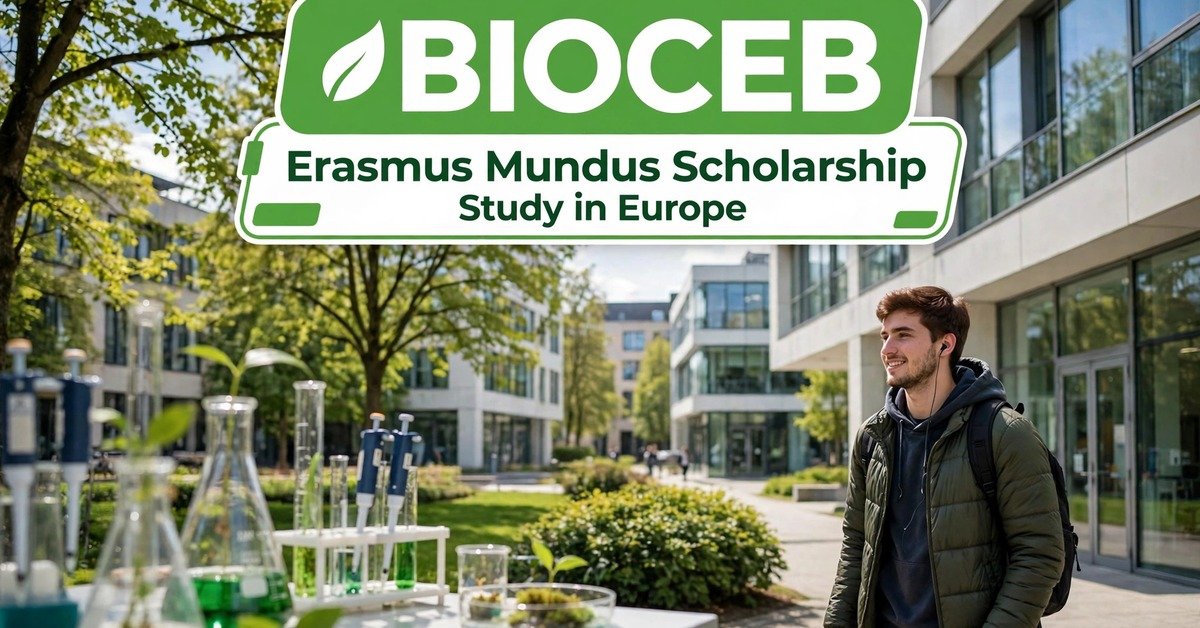
The Bioceb Erasmus Mundus Scholarship pays for a two-year joint master’s degree in biological and chemical engineering for a sustainable bioeconomy, taught across five universities in France, Finland, Belgium and Estonia. The best-ranked applicants receive up to €33,600, paid at €1,400 a month for up to 24 months, covering participation costs, travel, visa and installation. Applications close on 19 January at 11:30 a.m. Paris time, through AgroParisTech’s online portal.
Bioceb is a full master’s degree worth 120 ECTS credits, taught completely in English, with the whole first semester spent together in Reims, France.
Key details at a glance
| Programme | Bioceb – Biological and Chemical Engineering for a Sustainable Bioeconomy |
| Degree | Two-year joint master’s, 120 ECTS, taught in English |
| Universities | AgroParisTech (France), Aalto (Finland), Liège (Belgium), Reims (France), TalTech (Estonia) |
| Scholarship | Up to €33,600 — €1,400 a month for up to 24 months |
| Deadline | 19 January, 11:30 a.m. Paris time |
| Results | April – all applicants are notified by email |
| Who can apply | Bachelor’s graduates in engineering or science with biology courses |
What you actually study
The bioeconomy means using plants, micro-organisms and other biological resources to make products, materials and energy without fossil fuels. Bioceb trains engineers who can design those processes, from the molecule to the factory.
The programme mixes chemistry, biology, economics and environmental science, and adds practical skills in modelling, data analysis and project work. You choose a track and spend each semester at a different university, so the cohort moves together and the degree stays coherent.
What the scholarship covers
The Erasmus Mundus scholarship goes to the best-ranked applicants. The official Bioceb brochure states that it covers participation costs, travel, visa, installation and subsistence, up to €33,600 in total. That amount is meant to cover living costs, so plan carefully: rent differs a lot between the five cities.
Not every admitted student receives a scholarship. Self-funded admission is also possible: participation costs are €9,000 per year for non-EU students and €4,500 per year for EU students.
Check yourself first: can you apply?
You need a Bachelor of Science degree, or an equivalent, of at least 180 ECTS in engineering or science, including courses in at least one biology-related subject such as biotechnology, biochemistry, microbiology, biophysics, bioprocess engineering or molecular biology.
You also need English at B2 level, and only specific tests are accepted: IELTS Academic 6.5 overall with at least 6 in Writing, TOEFL iBT 92 overall with at least 22 in Writing, Cambridge C1 Advanced or C2 Proficiency, and Pearson PTE Academic 62 overall with at least 54 in Writing. TOEFL Essentials and TOEFL ITP are not accepted. No test is needed only if your degree was taught in English in an EU/EEA country or an English-speaking country, certified by your university.
Do not apply if your degree has no biology-related courses at all, because the eligibility check will stop your file before assessment. Do not apply if you cannot meet the English scores or provide the full set of documents. Final-year students can apply with a university document confirming this and the expected graduation date.
How the selection works
Bioceb calls its selection extremely selective. Academic excellence counts for 35 percent and is judged on your bachelor’s results, grades, GPA and university ranking. Only bachelor’s results count, even with a master’s degree. Your motivation letter counts for 20 percent, the interview for 25 percent, experience for 10 percent, and the two reference letters for 10 percent.
Shortlisted candidates are invited to a 20 to 30 minute online interview about their motivation and their choice of study track. Every student must also complete at least two study periods of 30 ECTS each in two countries, both different from the country where you live when you enrol. If you prefer different mobility, compare the Erasmus Mundus MESPOM Scholarship or the Erasmus Mundus IMSISS Scholarship first. After the deadline, the Secretariat checks files for eligibility and evaluators assess the rest; all applicants are notified in April.
Documents you need to prepare
The application is entirely online, and no document may be sent by post or email. Start early, because translations and reference letters take time. Give your motivation letter the most care: it is worth a fifth of your score.
- Passport with your photo, expiry date and personal details. A national ID card is accepted for European applicants only.
- Proof of residence in English, dated within three months before applications opened.
- CV in English and PDF format, preferably Europass, with dates for education, work, internships and skills.
- Motivation letter to the Bioceb Consortium, maximum two pages, in English and PDF format.
- Degree certificate, or a temporary certificate, plus official transcripts for each year of your bachelor’s degree.
- Two reference letters from two different referees, who upload them themselves. Warn them early and ask them to check spam folders.
- Proof of English level, unless exempt, and documents covering any gap since graduation.
How to apply
Applications are made through the AgroParisTech online application tool. Ask your two referees now. Prepare your documents, check every file is in English and PDF format, then upload everything and validate your application before the deadline. Only validated applications are considered. Also compare the Erasmus Mundus MAPP Scholarship in Public Policy, which follows a different timetable.
Frequently asked questions
Q: Is the Bioceb Erasmus Mundus Scholarship fully funded?
A: The scholarship covers participation costs, travel, visa, installation and subsistence, up to €33,600, paid as €1,400 a month for up to 24 months. It goes only to the best-ranked applicants.
Q: Can I apply before I finish my bachelor’s degree?
A: Yes, if you are in your final year. Your university must confirm this and state your expected graduation date.
Q: Do I have to study in two different countries?
A: Yes. Every student must complete two study periods of 30 ECTS each in two countries, both different from the country where you live when you enrol.
Is the Bioceb Erasmus Mundus Scholarship fully funded?
The scholarship covers participation costs, travel, visa, installation and subsistence, up to €33,600, paid as €1,400 a month for up to 24 months. It goes only to the best-ranked applicants.
Can I apply before I finish my bachelor’s degree?
Yes, if you are in your final year. Your university must confirm this and state your expected graduation date.
Do I have to study in two different countries?
Yes. Every student must complete two study periods of 30 ECTS each in two countries, both different from the country where you live when you enrol.
