
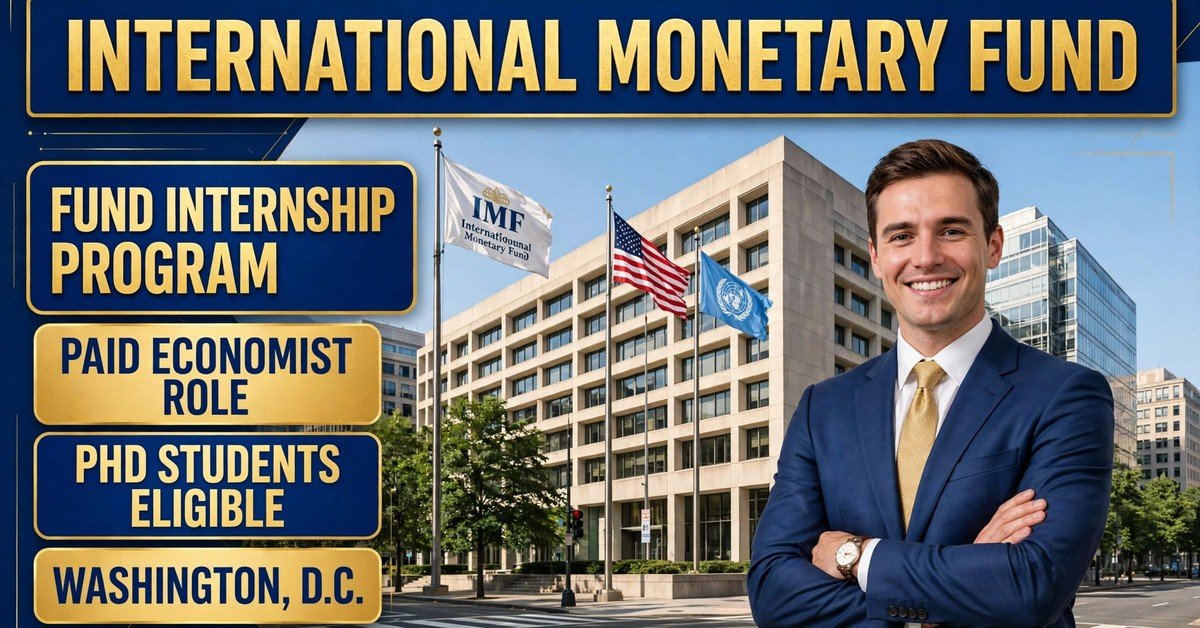
The International Monetary Fund is inviting PhD students to join its Fund Internship Program as economists in Washington, D.C. This is a paid, full-time, on-site internship, and applications close on December 5.
Interns spend ten to twelve weeks working directly with experienced IMF economists on real policy questions that matter to the IMF’s 191 member countries. The program runs June 7 to August 27, forty hours per week.
Important: this is not the same as the IMF Economist Program, which is full-time employment for professionals. The Fund Internship Program is a short summer internship for students.
The key facts at a glance
| Opportunity | Fund Internship Program — Economists |
| Organisation | International Monetary Fund (IMF) |
| Location | Washington, D.C., USA (on-site, full-time) |
| Duration | 10–12 weeks, June 7 to August 27 |
| Who should apply | PhD students in macroeconomics or related fields |
| Application deadline | December 5 (apply early) |
| Compensation | Paid — competitive salary, plus round-trip economy airfare and limited medical insurance |
| Documents needed | CV, statement of interest, transcript, technical questionnaire |
Who this internship is built for
The program is open to PhD students in macroeconomics or a related field — within one or two years of completing the PhD, enrolled during the internship, and returning to studies afterward. A strong candidate also meets these points:
- Under 32 when the internship starts in June (exception for mandatory military service)
- Excellent spoken and written English
- Strong analytical, quantitative, and computer skills
Who should not apply
The program has hard rules. Previous participants of the Fund Internship Program may not reapply — not even after a year. If you have already finished your PhD and are no longer a student, you do not qualify. And if your background is purely non-quantitative, this economist internship will not suit you.
What you get paid — and what you pay yourself
The internship is paid, and the IMF describes the compensation as a competitive salary. The exact figure is not published, so do not trust any website that claims to know it. Interns also receive restricted round-trip economy-class airfare between their university and Washington, D.C., plus limited medical insurance.
But one large cost is not covered: housing. Interns must arrange and pay for their own accommodation in one of the most expensive cities in the United States. Plan for this before you apply. Non-US applicants will generally need a G4 visa, and the IMF provides supporting documentation for the process.
What the work really looks like
Each intern receives an individual research or project assignment alongside an experienced IMF economist. The questions are real policy questions — the kind that feed into the IMF’s work for its 191 member countries. Some interns present their findings, and the best work can be published inside the IMF.
Not the same as the IMF Economist Program
People mix these two up every year. The IMF Economist Program is a full-time professional job for economists, with its own separate application process. The Fund Internship Program is a short summer internship for PhD students. If you want full-time employment, read our guide to the Economist Program instead.
How to apply
Applications go only through the IMF’s official careers system. Follow these steps:
- Prepare your CV, highlighting research and quantitative skills.
- Write your statement of interest — explain how your PhD research connects to the IMF’s work.
- Get your transcript or a university letter confirming enrolment.
- Complete the technical questionnaire carefully.
- Submit everything through the IMF careers portal before December 5.
How to make your application stand out
The technical questionnaire is where many strong candidates separate themselves. Answer every question carefully and double-check your calculations — the IMF tests how you think, not just what you know.
Your statement of interest should connect your PhD research to the IMF’s actual work. Read a recent IMF publication related to your field first. A short, specific statement beats a long, generic one. And apply early — early applications get the full attention of the selection team.
What happens after you submit
Competitive internship applications usually take weeks to review. Do not follow up right after the deadline — selection teams contact candidates directly, and decisions are usually communicated by email or through the careers portal you applied on.
While you wait, keep your other options open. Apply to similar opportunities in parallel, so you are never stuck waiting on one decision. If you are not selected, treat the application as useful practice — your statement of interest can be improved and reused for the next opportunity.
If the PhD track does not fit you
Professionals working with public-sector data should look at the World Bank Government Analytics Fellowship 2027. For a broader internship at an international organization, the WIPO Internship Programme in Geneva is worth a look.
Frequently asked questions
Q: Is the internship paid?
A: Yes — a competitive salary, plus round-trip economy airfare and limited medical insurance. The exact figure is not published.
Q: Does the IMF provide housing?
A: No. Interns arrange and pay for their own housing in Washington, D.C.
Q: Who can apply?
A: PhD students in macroeconomics or a related field, within one to two years of completing the PhD, enrolled during the internship, returning to studies afterward, and under 32 when it starts. Excellent English and strong quantitative skills are required.
Q: Can I apply if I did the internship before?
A: No. Previous participants may not reapply.
Q: What visa do non-US applicants need?
A: Generally a G4 visa. The IMF provides supporting documentation.
Q: Is this the same as the IMF Economist Program?
A: No. The Economist Program is full-time professional employment. This is a summer internship for PhD students — separate opportunities, separate applications.
Q: What documents do I need?
A: A CV, a statement of interest, a transcript or university enrolment letter, and the completed technical questionnaire.

2 thoughts on “IMF Fund Internship Program 2027 – Paid Internship for PhD Economists in Washington, D.C.”