
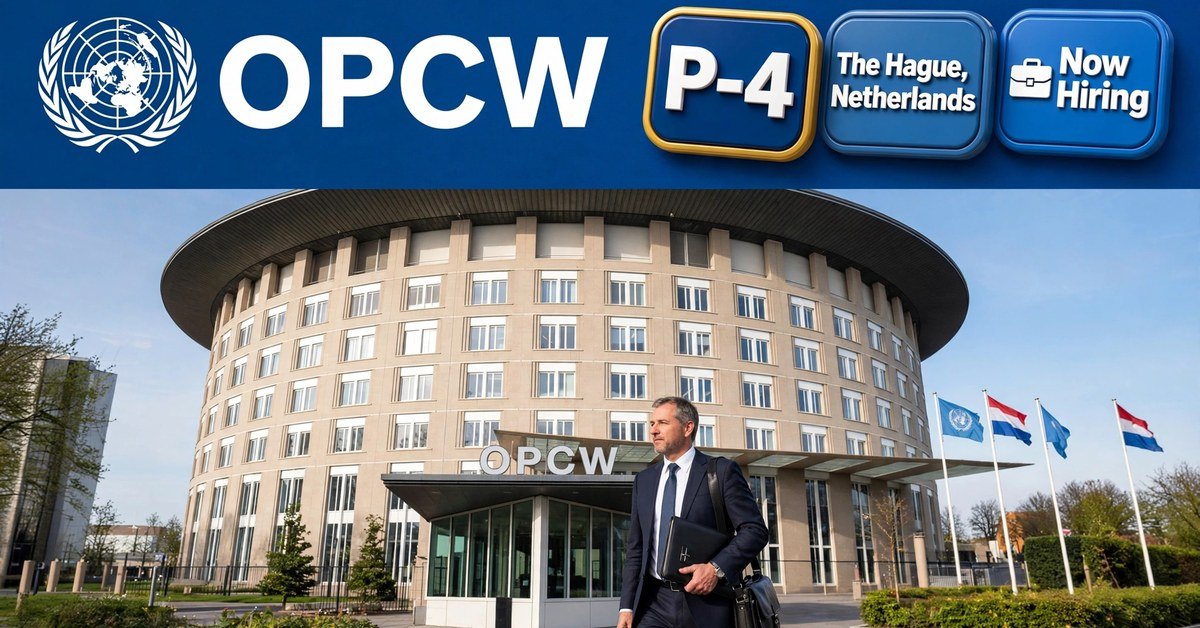
The Organisation for the Prohibition of Chemical Weapons — the body that won the Nobel Peace Prize in 2013 for eliminating chemical weapons — is hiring a Senior Chemical Demilitarisation Officer at the P-4 level.
The estimated monthly pay is about 10,372 US dollars, and the appointment is a fixed-term contract of two years. Applications close on 16 November at 22:00 Netherlands time. This is a senior specialist role, not an entry point — read the requirements carefully before you apply.
The key details at a glance
| Detail | What the official vacancy says |
| Organisation | OPCW (Organisation for the Prohibition of Chemical Weapons) |
| Role | Senior Chemical Demilitarisation Officer |
| Grade | P-4 (Professional) |
| Location | The Hague, Netherlands |
| Contract | Fixed-term, 2 years (6-month probation) |
| Estimated monthly pay | About USD 10,372 (depends on post adjustment and family status) |
| Deadline | 16 November, 22:00 Netherlands time |
What this job actually involves
The Chemical Demilitarisation Branch checks that countries keep their promises under the Chemical Weapons Convention. In plain terms: when a country says it has destroyed its chemical weapons, OPCW verifies it.
Your work would include reviewing countries’ declarations and destruction plans, preparing detailed verification plans for chemical weapons storage and destruction facilities, and agreeing those plans with the countries concerned. You would assess destruction technologies and monitoring equipment, and make sure on-site verification is done properly and cost-efficiently.
You would also instruct and advise inspection teams before and during missions, review their reports, and draft official correspondence. Beyond inspections, you would provide technical input to the organisation’s reports, advise the Scientific Advisory Board, lead knowledge management for verification work, and support the training of inspectors. From time to time, you would join inspections yourself and represent the organisation at international events.
The pay and contract, in plain terms
The page lists an estimated total monthly remuneration of 10,372 US dollars. The word estimated matters: the final amount depends on the post adjustment for The Hague and your family status.
The appointment is fixed-term for two years, with a six-month probation period. Here is the part many applicants miss: the OPCW is a non-career organisation. Total service for Professional staff cannot exceed seven years. This is not a job you hold for decades — plan accordingly. The mandatory separation age is 65.
Two more honest details from the page. The Director-General may decide not to appoint anyone, or to appoint at a lower grade. And several vacancies may be filled from this announcement — so the competition is real, but so is the opportunity.
Do you qualify? Read this first
This is a hard-gated role. Check each requirement honestly.
- Education (essential): an advanced university degree in chemistry or chemical engineering. A first-level university degree plus qualifying experience may be accepted instead.
- Experience (essential): at least 7 years of relevant experience in chemical demilitarisation or chemical weapons technology with a Master’s degree — or at least 9 years with a first-level degree.
- Languages (essential): fluency in English. A good working knowledge of Arabic, Chinese, French, Russian, or Spanish is desirable.
Desirable extras include experience with ICT tools, international-level work, disarmament verification regimes, knowledge management training, and working in toxic environments while wearing protective equipment. The page also lists the personal qualities expected: analytical thinking, problem-solving, planning under pressure, excellent communication, and tact in a multicultural environment.
You should probably not apply if:
- You do not have a chemistry or chemical engineering background.
- You have fewer than 7 years of relevant experience (with a Master’s).
- You are not fluent in English.
- You are looking for a permanent, decades-long appointment — the 7-year service limit rules that out.
How to apply
Applications go through the OPCW CandidateSpace portal — only fully completed applications submitted there before the closing date are considered. The vacancy closes at 22:00 Netherlands local time on 16 November, after which the announcement disappears from the portal. Apply well before the deadline.
Only applicants under serious consideration are contacted, so do not expect an acknowledgment. Make sure your application is complete: an incomplete file is not considered at all. You can also browse other openings on the OPCW employment page.
More international organisation careers: the ICC Document Management Assistant role in The Hague and the IMF Economist Program.
Questions applicants ask
What does a Senior Chemical Demilitarisation Officer actually do?
You help verify that countries are destroying their chemical weapons as promised under the Chemical Weapons Convention. That means reviewing destruction plans, preparing verification plans for weapons facilities, advising inspection teams, reviewing their reports, and providing technical input to the organisation’s leadership.
What is the salary?
The official vacancy lists an estimated total monthly remuneration of about 10,372 US dollars. The final amount depends on the post adjustment and your family status.
Is this a permanent job?
No. It is a two-year fixed-term appointment with a six-month probation period. The OPCW is a non-career organisation, and Professional staff cannot serve more than seven years in total.
Where is the job based?
At the OPCW headquarters in The Hague, Netherlands. The role involves travel for inspections and technical visits.
What happens if I apply after the deadline?
Late applications are not possible. The vacancy closes at 22:00 Netherlands local time on 16 November, and the announcement is then removed from the candidate portal.
Will I hear back after applying?
Only applicants under serious consideration are contacted. Make sure your application is fully complete, because incomplete applications are not considered.
