
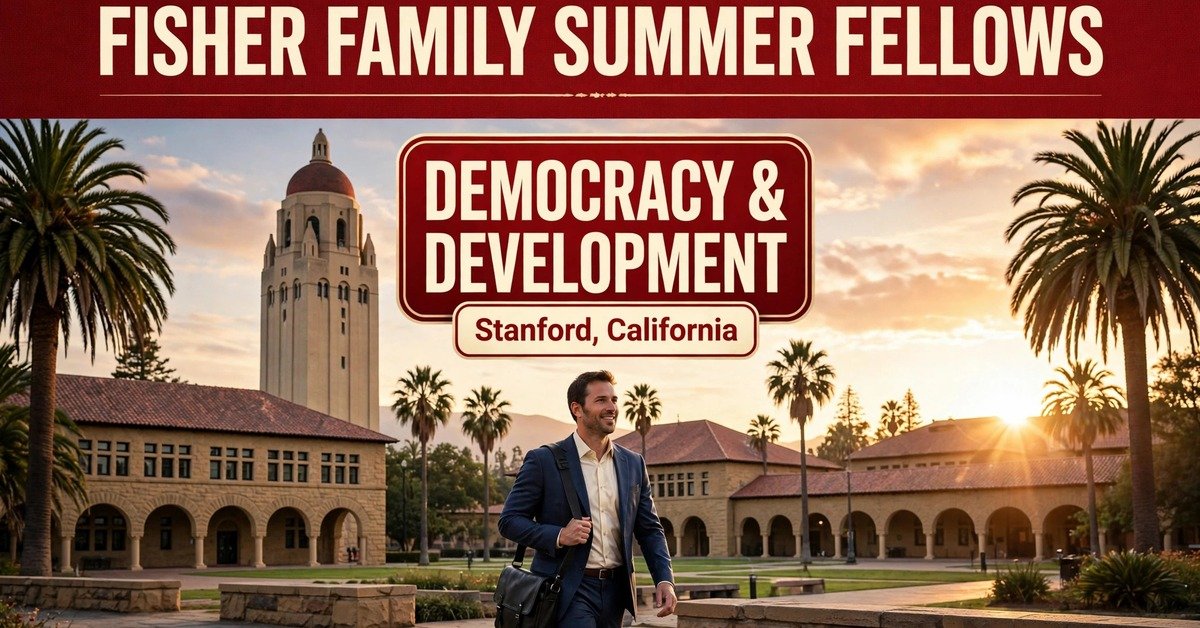
Applications are now open for the Fisher Family Summer Fellows Program on Democracy and Development at Stanford University — a three-week, on-campus program for mid-career democracy and development practitioners, running July 18 to August 6.
The deadline is January 12, 2027, at 11:59 pm PST, and about 28 to 30 fellows are chosen from hundreds of applicants — so submit a complete file early, including your recommendation letters.
Key facts at a glance
| Detail | What the official pages say |
|---|---|
| Program | Fisher Family Summer Fellows Program on Democracy and Development |
| Host | Stanford University’s CDDRL |
| Location | Stanford campus, California, USA |
| Dates | July 18 – August 6 (3 weeks on campus) |
| Cohort | About 28–30 mid-career practitioners |
| Who it is for | Practitioners advancing democratic reform in transition countries |
| Deadline | January 12, 2027, 11:59 pm PST |
| Letters | 2–3 letters of recommendation |
| Costs | Not itemized on the official pages |
| Apply | Online portal (button below) |
Who this fellowship is for
This is for people already doing the work: mid-career practitioners from countries in political transition, advancing democratic reform where freedom and good governance are fragile. Fellows have come from “Afghanistan to Zimbabwe,” and alumni now number over 500 leaders from 96 countries.
You may be a strong fit if you:
- Work full-time on democracy, development, or governance in a transition country.
- Hold a leadership role affecting other people or organizations.
- Can point to concrete work — campaigns, policies, organizations.
- Can commit to the full three weeks without interruption.
Skip this if you are early in your career or in a full-time degree program — the teaching assumes experienced practitioners. If you are still building your record, a younger-leaders program like Dalai Lama Fellows may suit you better.
What the three weeks look like
Fellows live on the Stanford campus and take classes tailored to the cohort, taught by faculty including Michael McFaul, Kathryn Stoner, Francis Fukuyama, Larry Diamond, and Erik Jensen. The focus is practical: models and frameworks for good governance back home.
Guest lectures have featured figures such as Law School professor Pamela Karlan and former Secretary of State Condoleezza Rice, alongside development foundations and US and California government officials. Each fellow also gives a “TED”-style talk about their backstory and work. The longer-term value is the peer network: alumni across 96 countries keep comparing notes long after the three weeks end, much like the model used by the Yale World Fellows Program.
A note on costs and funding
The official pages do not itemize what the program covers: fellows live at Stanford and take classes on campus, but the pages do not say which costs the program pays and which fall on the fellow. Do not assume full funding — plan your own costs realistically, and contact the program team before applying if expenses would decide whether you can attend. No application fee is mentioned on the official pages.
How to apply for the Fisher Family Summer Fellows Program
The application runs through an online portal (button below). The recommendation letters deserve your full attention — the official guidance says they “weigh heavily in the review process.”
- Open the portal via the button below.
- Complete the online application with your details and background. Be specific about your work — this program selects people on their record.
- Add two or three referees in the “References” section (“Add Reference”), including your current supervisor — founders can use a co-founder, board member, or oversight authority. Letters must come from professional associates, never family or friends.
- Brief and chase your referees. The system sends them instructions and an upload link; add a personal note on what the program values, and follow up yourself.
- Meet the letters deadline. All letters must arrive by January 12, 2027; files with fewer than two letters are not reviewed.
Ukrainian applicants use the same portal: indicate interest in the concurrent Strengthening Ukrainian Democracy and Development (SU-DD) program for supplemental questions about your proposed project — or apply for the three-week fellowship on its own.
Before you start your application
The biggest risk with this application is the letters, not the form. Senior people are slow to write recommendations, and missing letters disqualify your file — so ask referees now, not in December, and give each a brief: what the program is, what to highlight, and the exact deadline. If a program alumnus nominated you, ask them for a letter — alumni nominations are reviewed favorably. On the written side, lead with evidence: one or two pieces of work you led, what changed because of them, and what you would do with three weeks of training.
Questions applicants often ask
Is there an application fee?
The official announcement and application pages do not mention any fee.
Is the program fully funded?
The official pages do not itemize covered costs, so do not assume full funding. Check with the program team if costs affect your decision.
How competitive is it?
Hundreds apply each year for about 28 to 30 places.
This is one of the few short fellowships built for democracy and development practitioners from transition countries. If your work fits, start now — secure your referees and file before January 12. Strong files are specific, not long: every answer should point at one concrete piece of work and the change it made.

One thought on “Fisher Family Summer Fellows Program 2027 at Stanford: Three-Week Democracy and Development Fellowship”